
Delivery App Commission Rates: What DoorDash, Uber Eats, and Grubhub Really Charge Restaurants in 2026

Every restaurant owner on delivery apps knows the same number: the commission. What most do not know is that the number on the signup page is the floor, not the bill. Each platform sells tiered plans, adds delivery and processing fees on top of some of them, and raises rates with little warning. This post lays out the published 2026 rates for DoorDash, Uber Eats, and Grubhub, what pushes the real cost above the headline rate, and how to check what you are actually paying.
Rates below are the published list rates as of October 2026, taken from each platform's merchant pricing page and reported by Restaurant Dive. Your signed agreement can differ, and some cities cap fees by law, so check your own rate card before quoting these numbers to anyone.
DoorDash: 15%, 25%, or 30% on Delivery
DoorDash sells three Marketplace plans, and the plan sets the rate:
Basic, 15% on delivery orders. The cheapest way onto the platform, with the least in-app visibility.
Plus, 25% on delivery orders. More visibility and promotion tools.
Premier, 30% on delivery orders. The top tier, with the most reach in the app.
Pickup orders cost 6% on every plan. DoorDash says card processing is included in the commission, with no activation fee and no payment processing fee on top.
The plan choice is a real trade-off, not a trick: a higher tier buys placement and promotions that can bring more orders, but each of those orders costs twice as much in commission as a Basic order. The math only works if the extra orders actually arrive.
Uber Eats: 20%, 25%, or 30%, and the Entry Tier Just Went Up
Uber Eats calls its charge a marketplace fee, and its tiers changed in 2026:
Lite, 20% on delivery orders. This tier was 15% until March 11, 2026, when Uber Eats raised it to 20%, according to Restaurant Dive.
Plus, 25% on delivery orders, rising to 30% on orders from Uber One members.
Premium, 30% on delivery orders.
Pickup is 7% if Uber Eats can confirm your in-app prices match your in-store menu, and 10% if it cannot. Like DoorDash, Uber Eats folds card processing into the fee.
The March 2026 increase is the one to watch. Restaurants that signed up on Lite at 15% saw their entry rate rise by five points with a fee-change notice, and restaurants with custom rates saw theirs rise three points, capped at 30%. If your Uber Eats costs jumped this spring and you never worked out why, that is probably it. The earlier rise is covered in Uber Eats just raised its fees again.
Grubhub: The Cheapest Headline Rate, With the Most Add-Ons
Grubhub splits its bill into pieces, which makes the headline rate look lower than the real one:
Basic, 5% marketing commission. Plus, 15%. All-access, 20%.
Grubhub Delivery adds a delivery fee starting at 10% when you use Grubhub's drivers. Deliver it yourself and that fee disappears.
Payment processing is extra: 3.05% plus $0.30 per order, on top of the commission.
So a Grubhub order on the Basic plan with Grubhub delivery costs about 15% plus processing, and a mid-tier plan with delivery runs around 25% all in, before promotions and refunds. The 5% headline is real, but only for a restaurant that delivers its own orders and skips the add-ons.
Why the Published Rate Is Never the Whole Bill
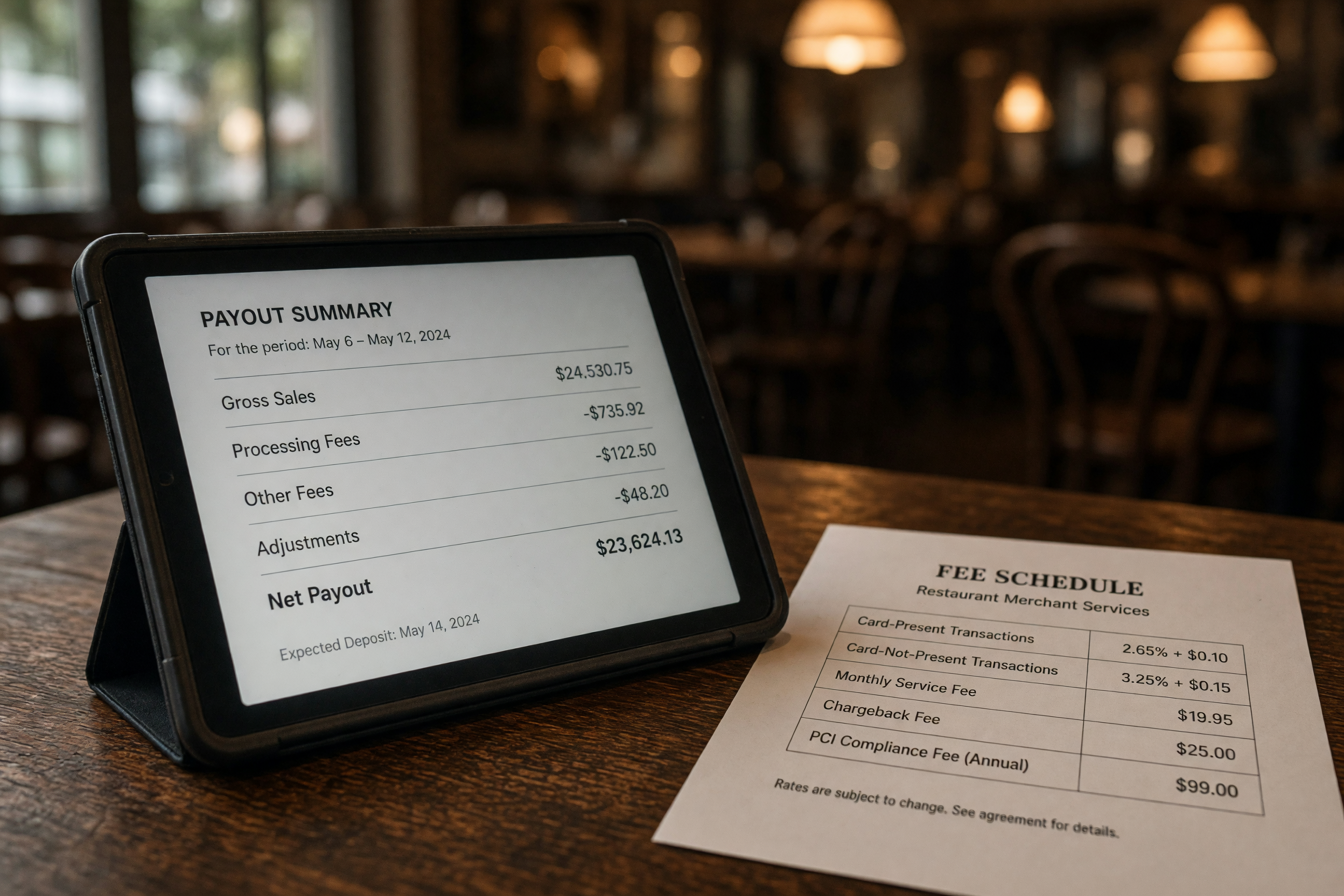
The commission is the first line, not the last. Four things push the real cost above it:
Promotions and discounts. The apps run the offer, and the restaurant often pays for it. Delivery app promotion fees and discounts shows who really pays.
Refunds. Every refund a customer gets comes out of your payout, and a large share of them are disputable. The scale of that is in the hidden cost of food delivery apps.
Chargebacks and fee errors. Bank chargebacks arrive with a fee on top, and wrong-rate lines hide on long statements. The catch is in how to audit your delivery app payout statement.
Packaging and labor for delivery orders. Boxes, bags, and the time to pack them are not in the commission, but they come out of the same order.
Independent 2026 cost analyses put the real, all-in cost of a marketplace order at 30% to 40% of the ticket once packaging, promotions, processing, and refunds are counted, and Restaurant Business reported in 2025 that it can reach 30% to 45%.
The published commission is the floor, not the bill. The real cost of a delivery order lands closer to a third of the ticket once everything is counted.
That matters because the margin underneath is thin. The National Restaurant Association's 2025 Restaurant Operations Data Abstract, covering more than 900 restaurants, puts the median pre-tax income at 2.8% of sales for full-service restaurants and 4.0% for limited-service restaurants. A 30% commission on a delivery order is ten times the margin on that same dollar for a typical full-service restaurant, which is why the fee lines deserve the same attention as the food cost.
How to Check What You Are Actually Paying
Run this on one recent payout statement from each platform, and it takes about ten minutes:
Step 1: Find your plan and rate. Check your merchant portal for the plan name and the rate on your agreement, then compare it with the published rates above. If your rate is higher than the published tier you think you are on, ask why.
Step 2: Add up every line, not just the commission. Marketing commission, delivery fees, processing, promotions, refunds, and adjustments. Divide the total by the order subtotal. That percentage is your real cost per order.
Step 3: Compare across platforms. The same order can cost 15% on one app and 30% on another, and the cheaper app is not always the one with the lower headline rate once delivery and processing are added.
Step 4: Dispute the lines that are wrong. Refunds on orders packed complete, canceled orders paid at zero, and fee lines that do not match your contract are all disputable. That is the work Jelly does full time: founded in 2021, Jelly audits every payout line and disputes bad charges for restaurants across hundreds of locations on DoorDash, Uber Eats, and Grubhub, has recovered more than $1.6M, and holds an 89% success rate on refund recovery. How the service works is in restaurant refund recovery service, and the plans are at gotjelly.com/plans, where Pro comes with a 30-day free trial.
Frequently Asked Questions
What commission does DoorDash charge restaurants in 2026?
DoorDash charges 15% on Basic, 25% on Plus, and 30% on Premier for marketplace delivery orders, and 6% on pickup orders across all three plans. Card processing is included in the commission.
What commission does Uber Eats charge restaurants in 2026?
Uber Eats charges a 20% marketplace fee on Lite, 25% on Plus (30% on Uber One member orders), and 30% on Premium for delivery orders. Pickup is 7% with validated in-store pricing, otherwise 10%. The Lite tier rose from 15% to 20% on March 11, 2026, per Restaurant Dive.
What commission does Grubhub charge restaurants in 2026?
Grubhub charges a 5% marketing commission on Basic, 15% on Plus, and 20% on All-access, plus a delivery fee starting at 10% when Grubhub drivers deliver, and payment processing of 3.05% plus $0.30 per order on top.
What is the real all-in cost of a delivery app order?
The published commission runs 15% to 30%, but independent 2026 cost analyses put the all-in cost at 30% to 40% of the ticket once packaging, promotions, processing, and refunds are counted, and Restaurant Business reported in 2025 that it can reach 30% to 45%.
Can restaurants negotiate lower delivery app commission rates?
Some restaurants, especially multi-location operators, hold custom rates rather than the published tiers. Check your signed agreement first, compare it with the published rates, and raise any rate above your tier with your platform rep. Either way, audit the statement: the rate on paper and the rate on the payout are not always the same.


Comments